Ai un copil plin de energie, cu simțul umorului și talentat? Sau poate este timid, dar cu poftă de joacă și vrea să iși facă prieteni noi? Ți-ai dori să își dezvolte abilitățile sau să le descopere?
Înscrie-l acum la cursul de dezvoltare personală prin teatru!
Screenplay Format – The complete and easy guide to formatting your script
Screenplay formatting made easy
There is lot of stress and online chatter about how to format a screenplay. What’s right and mostly what’s not.
I want to assure you that when you finish reading this post you’ll know how to format your script.
And more importantly you’ll know there is nothing to fear, and that it is not that important to begin with.
Industry standard open doors
You can have someone fix your formatting on fiverr or other services
for 15$. This means you need to focus on your script – Plot, charaters,
dialogue. Industry-standart formatting is great, but anyone can do it.
In fact EVERY SCREENWRITING SOFTWARE does that automatically.
You need to write the best script you can.
My goal here is to get you familiar with formatting so that you don’t stress over it and free your self to actually write.
Don’t obsess over formatting, learn the basics so you write in industry-standard but please don’t waste time or stress over it.
Proper formatting is important for two reasons:
Your script will read better.The reader will easily understand your vision and will enjoy the story more.
Production companies and agents get a lot of materials. If your script doesn’t look professional, they might not read it.
Make sure you submit a script that follows industry-standard.
You can still use this guide. (From my experience Americans seems to take formatting more seriously than anywhere else).
How to format a screenplay and not lose your mind
We’ll go step by step over all the main formatting elements.
All the example’s are from the pilot episode of Grey’s Anatomy.
Fonts
Font: Courier.
Font Size: 12 points.
This way the rule of thumb of 1 page=1 minute on screen, is kept. Mostly.
Scene Heading (AKA Slug Line)
Every scene starts with a scene heading or a slug line (same thing, different name). A scene heading or a slug line is a short description that indicates where and when the scene takes place. The scene heading offers crucial information for all the production departments, as well as the reader. Every scene heading has 3 elements: 1. Interior or Exterior Int = Interior. Ext = Exterior. Int/Ext = Both. 2. Location 3. Time of day
Slug lines are in All CAPS.
Use the FORWARD SLASH If the scene takes place in 2 or more locations. If the character is on the move, a phone call. Etc.
Remember, the whole point is to be understood. As long as your choice is elegant and clear you’ll be fine.
Action
This part describes what will be seen and heard on screen.
Lets see how the great Shonda Rhimes did it:
Character
1. The first time a character appears in the script.
The character’s name in CAPS or BOLD or both.
Age – in parenthetical.
Mention age for main and repeating characters only unless there is a specific need to know the age.
(This is important for casting)
Add a short description of the character.
2. Character’s name in the action line
Just write the name. Nothing to it.
3. Character’s name in dialogue.
CAPS , CENTERED and ABOVE the dialogue. Easy.
Dialogue
What the character says is written below the character’s name, in the center of the page.
VOICE OVER
When
the character talks, but the other characters can’t hear. Usually, it
is used as the character’s inner voice, narration etc.
Parenthetical
There seems to be a lot of misunderstanding when it comes to using parenthetical in a script.
Using
parenthetical correctly can make your script better. Just as using too
much of it or misusing it can make reading your screenplay a tiring
experience.
If you are not sure you wrote your script in the right format, do one or more of these:
Read screenplays of
show and films that were produced and broadcast, preferably ones you
liked to watch (it’s just more fun that way). See how the pros did it.
You can find free screenplays to read here and here.
Use a screenwriting software. There are great free options out there, like this one and this one.
I think you will agree with me that you can’t sell a script without a killer log line.
In
this guide I will show you WHY you need a gripping log line, HOW to
write a log line that will open doors for you, PLUS EXAMPLES from the
best log lines of the best series and films out there. This is a guide you can’t miss. Let’s start!
WHY DO NEED AN OUTSTANDING LOG LINE
You can have a great screenplay or a TV series bible, but if the log line isn’t good – no one will ever read it.
It
took me years to understand the importance of a strong log line. Once I
realized it is an essential part of the craft, I researched for the
best way to write it. Reading
and analyzing log lines, I found guidelines you can follow in order to
write a professional, effective and compelling log line quickly and
easily.
What is a Log Line in screenwriting?
A good log line is a 1- to – 3 sentence summary of your film/series, that hooks the reader instantly.
ou can think of a log line as an ultra-condensed version of your story. In every story, there is someone that wants something but is having trouble getting it. This is the essence of drama.
In other words, the log line should state WHO will face OBSTACLES and CONFLICTS, WHERE he or she is, and what they need to do to get WHAT they want.
Let’s look at an example:
The Handmaid's Tale Log Line
Set in a dystopian future, a woman is forced to live as a concubine, under a fundamentalist dictatorship
WHO – a woman.
WHAT – forced to live as a concubine.
OBSTACLES/CONFLICTS – under a fundamentalist dictatorship
WHERE – a dystopian future.
Log Line examples:
This is important!
A log line forces us to identify the core elementsof our script (that is why it can be so excruciating to write.) It requires us to truly understand what the script is all about.
As hard as it is, it is also a gift to us as screenwriters. It is not just for marketing or a part of a sales pitch. It is a screenwriting tool, and the sooner we apply it to our script, the better.
WRITE
Now
that you know what a good log line is, what key elements are needed to
write a one, and why you need it, It is time to write your own.
Take your time. Write and rewrite it as much as you need.
Remember: Who, What, Obstacle, Where.
Final Tip
If you try and try and it doesn’t seem to work, it might mean there is a lack of focus in the script or concept.
In that case, go back to your treatment and try to identify if the main character’s goal is clear.
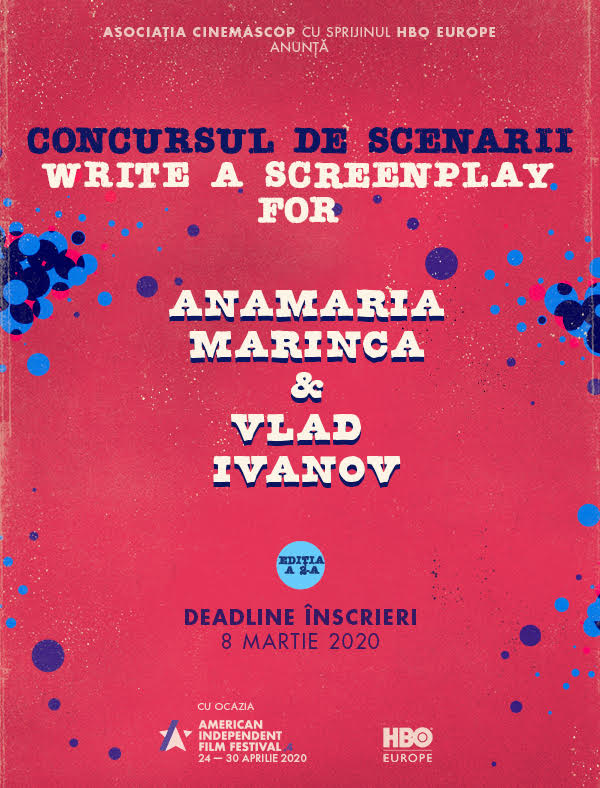
WRITE A SCREENPLAY FOR /SCRIE UN SCENARIU PENTRU ANAMARIA MARINCA & VLAD IVANOV
Asociația Cinemascop cu sprijinul HBO Europe lansează a 2-a ediție a concursului de scenarii: WRITE A SCREENPLAY FOR…/ SCRIE UN SCENARIU PENTRU…, organizat la American Independent Film Festival, în București, în perioada 24-30 aprilie 2020.
Scenariști de limba română, experimentați sau începători, sunt invitați să-și trimită propunerile (outline-uri) până pe 8 martie 2020, la adresa: info@cinemascop.eu
Outline-urile pot fi scrise fie pentru filme de lungmetraj ficțiune, fie pentru o miniserie TV de 6 episoade. Atât proiectele de lungmetraj, cât și cele de miniserie TV, trebuie să îi aibă pe unul dintre cei doi actori sau pe amândoi, în roluri principale.
Un
juriu format din echipa HBO și scenaristul Alexandru Baciu va analiza
toate propunerile primite și va alege o listă scurtă de proiecte rămase
în concurs.
Autorii proiectelor aflate pe lista scurtă vor fi invitați la o sesiune de pitching în perioada 10-12 aprilie, la București, urmând ca finaliștii să fie anunțați public pe 24 aprilie, în cadrul galei de deschidere a festivalului American Independent Film Festival. Pe durata festivalului, între 24 și 30 aprilie, aceștia vor participa la o serie de workshop-uri unde proiectele lor vor fi dezvoltate cu consilierea unor script doctors.
Invitații speciali ai acestei ediții, actorii Anamaria Marinca și Vlad
Ivanov, împreună cu specialiști în domeniu, vor analiza proiectele
finaliștilor și vor alege câștigătorii. Aceștia vor fi anunțați pe 30
aprilie 2020. Autorii proiectelor câștigătoare vor primi o primă de
dezvoltare nerambursabilă în valoare de 1000 € pentru dezvoltarea proiectelor până la faza de scenariu.
IBAN RO63BTRLRONCRT0246793101 - cont în Lei
IBAN RO13BTRLEURCRT0246793101 - cont în Euro
BIC - Swift BTRLRO22
IBAN RO17BTRLUSDCRT0246793101 - cont în USD
UPFAR ARGOA lansează în cadrul
FESTIVALULUI INDIE AL PRODUCĂTORILOR INDEPENDENȚI IPIFF 2019 ediția a
XIV-a un CONCURS DE SCENARII de lung-metraj și scurt-metraj de ficțiune
Bucuresti - 08 octombrie 2019 -
Prin acest proiect IPIFF 2019 ediția a XIV-a
își propune să devină un punct de întâlnire între scenariști, regizori
și producători din România, dar să le și ofere o deschidere spre
industria europeană de film.
Concursul
îi va și ajuta pe cei care sunt interesați de valorificarea unuia din
scenariile alese să înțeleagă mecanismul european de susținere a
cinematografiei, modalitățile prin care se pot perfecționa proiectele cu
ajutorul workshop- urilor de specialitate din cadrul uniunii europene,
și va facilita proiectelor într-o etapă mai avansată, întâlnirea cu
posibili coproducători din țări partenere fondului European media.
Termen limită de înscriere –31 Octombrie 2019
Selecție proiecte – 10 scenarii lung metraj și scurt metraj – mijloc noiembrie
Pentru regulamentul si detaliile concursului va rugam sa acesati www.ipiff.ro
The 18th Annual Script Pipeline Screenwriting Competition connects
talented writers with production companies, agencies, and managers who
can help launch their career. As one of the longest-running and most
successful screenplay contests, we focus specifically on finding writers
representation, supporting diverse voices, championing marketable,
unique storytelling, and pushing more original projects into production.
Recent films from Script Pipeline contest winners include Fox's Stuber and the indie hit The Standoff at Sparrow Creek.
The company’s intensive process, consisting of long-term writer
development and widespread circulation of material, gives Script
Pipeline writers access to some of the top industry execs worldwide. $7 million in screenplays and pilots have been sold by competition finalists and "Recommend" writers,
with several scripts produced since 1999. As of summer 2019, over 10
films and series from Script Pipeline writers are in active development
or production, with some due for release later this year.
Finalists receive circulation to Script Pipeline partners, in addition to the following:
$25,000 to winner, $2,500 to runner-up
Introductions to managers, producers, agents, directors, and others searching for screenplays
Long-term script circulation to industry and continual guidance connecting with companies
Development assistance from Script Pipeline's senior execs
Additional script reviews and consideration of other material for industry exposure
Invitations to writer and industry events hosted by Pipeline Media Group
All entrants may request a no-cost call with our Creative Executive,
who can answer general questions on the industry or the Script Pipeline
process.
Deadline Dates
Pre-registration: December 31st, 2019 – $40
Early: March 1st, 2020 - $55
Regular: May 1st, 2020 - $60
Late: May 15th, 2020 - $70
Enter the 2020 season by filling out the form on the right-hand side of this page. Writers may register at any time. There is no additional fee to send an updated draft from now until the regular May 1st deadline.
Entries also accepted via:
"I cannot overstate the impact that
Script Pipeline has had on my writing career. Winning the contest
directly led to new representation, which in turn led to working with
studios like 20th Century Fox and Amazon."
- Tripper Clancy (Stuber)
Organizațianon-profitșinon-guvernamentalăUNIFEROInc.vă invită să participați la alV-leaConcursanualdeCreațieLiterarăpentruAdulți,din cadrul celei de a XII-a Conferințe InternaționaleUNIFEROInc.,concurs deschis între10 ianuarie – 10 iunie 2019.
Se acordă Premiile I, II, III și trei mențiuni. Câștigătorilor aflați
la Conferință li se vor înmâna Diplome și premii în obiecte
Tematica (la alegere):
1. Povestiri pentru copiii lumii - Femei /dascali/ creatori de excepție din România sau din altă țară, implicati în evolutia invatamantului si /sau in evenimente istorice(ex. Regina Maria, Ana ASLAN, Jean d’Arc,Maica Smara (Smaranda GHEORGHIU), Hilary CLINTON, Michelle OBAMA, Oprah WINFREY / Spiru HARET, etc.).
Povestirea va avea până în 3 (trei) pagini, cu paragrafe. Textul poate fi însoțit și de o pagină cu grafică/desen propriu ca ilustrație (extra pagină).
2. Pagini de Jurnal - Un eveniment întâmplat în anii de școală / facultate care v-a afectat viața / O femeie dascăl și motivul pentru care vă amintiți de ea 3 (trei) pagini.
Pentru tema 1 - se va menționa Bibliografia în finalul povestirii (cel puțin 2 cărți și 2 website-uri/info de pe net).
Pentru tema 2: Jurnalul va fi scris la persoana I;
Pentru oricare dintre cele două teme alese, Juriul va lua în considerare limbajul corect, stilul clar, lipsit de ambiguități, atractiv, original, exprimând opinii personale.
Regulament concurs:
·Lucrarea dactilografiată (TimesNewRoman, mărime 12, distanța de 1.5 între rânduri)trebuie să aibă un Motto în colțul din dreapta sus pe prima pagină.
·Un alt word doc trebuie să includă:
Numele exact, profesia, adresa poștală, adresa de email, numărul de
telefon, o fotografie inclusă în text, scurt CV literar, dacă există.
Fiecare participant va trimite lucrarea prin email ca anexa în acest format (motto, etc.) la adresele:
 Înscrie-l acum la cursul de dezvoltare personală prin teatru!
 Detalii si inscrieri la 0733 246 904